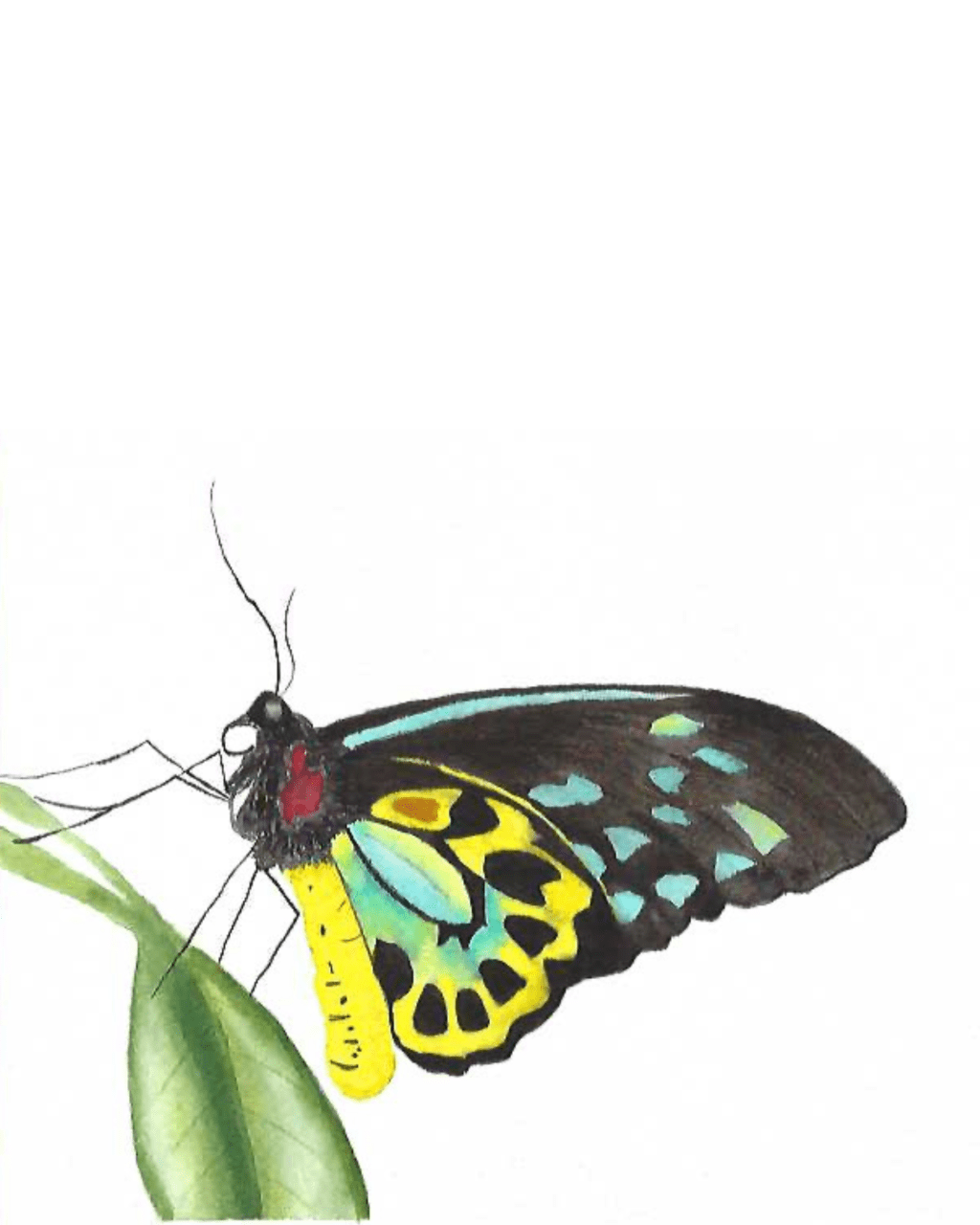
Watercolor is an interesting medium. It can be rather unforgiving if you haven’t planned well, but on the other hand, it allows you to go back later and fix mistakes you’ve made — or at least lessen their impact.
I’ve been trying to get my nerve up to tackle the eagle project for my Hubby again. As I talked about a couple of weeks ago, I couldn’t just jump back in — I needed to do some easier practice things first. Last week, I still hadn’t gotten up my nerve, so I went to my Watercolor Mastery Course. Like I’ve done before, I decided to trace one of Emily’s line drawings and try to paint it using just the reference photo, not the tutorial. I chose a Cairns Birdwing Butterfly that she had as one of her daily challenges.
This was a lot of fun to paint, and I was really happy with it when I finished. But then I had a thought — “What if I used my iridescent paint as a glaze over it to mimic the shine we see on the butterfly’s wing?” Now I only recently got my iridescent paint, and I hadn’t actually used it on a painting. I had tried it out in my sketchbook, but not enough to know exactly how it would behave as a glaze.
After my little experiment, I’m still not sure how it will behave. That’s because I’m not completely sure why things went off the rails. I suspect that the real problem was that I hadn’t let the part I was glazing dry enough before I started.
That’s the thing with watercolor — if you don’t want a muddy mess, you have to let each layer dry before putting another on top of it. If I had been smarter, I’d have used my drying tool just to make sure it was good and dry. Anyway, as I glazed over the wings, I noticed the black starting to creep across the lighter-colored areas. On top of that, some of the black started looking a LOT lighter.
Looking at it after I finished, I thought it was ruined. No big deal; it was just a practice piece anyway.
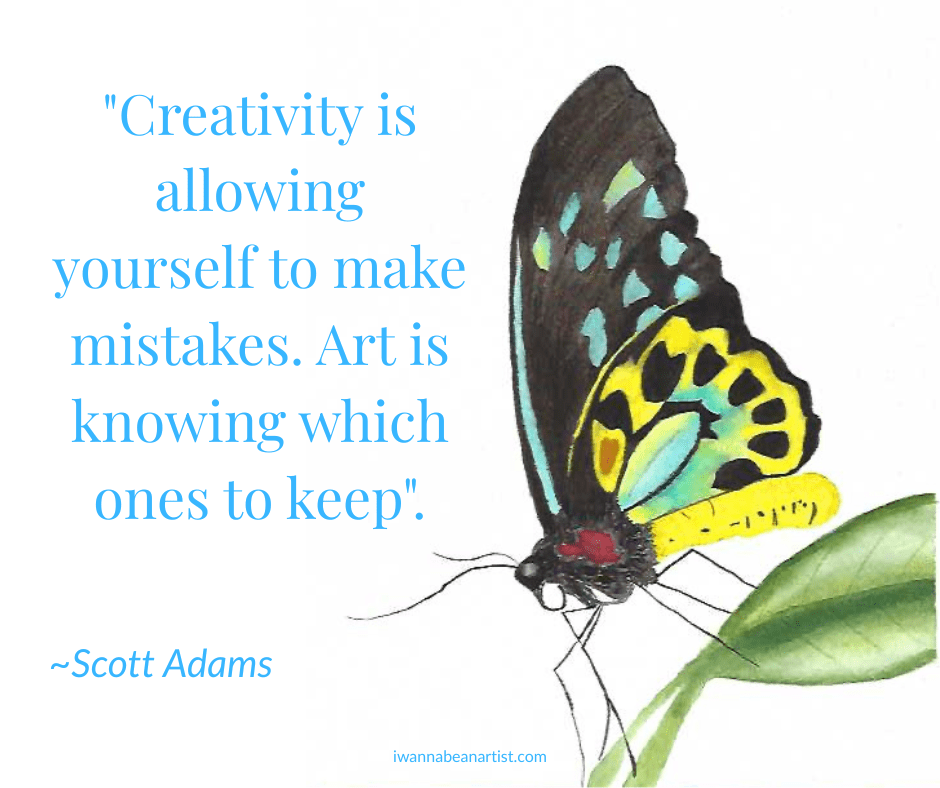
Later, though, I went back in to look at it, and I thought it might be salvageable. There was no fixing the black that had smeared into the lighter colors, but that really wasn’t a major problem, as there are light black streaks in the lighter-colored areas of the actual butterfly. The bigger problem was that the edges of the black areas looked smudged and of course, some of the black looked too washed out.
I just went back in and strengthened the lines again, then added a little more black to the areas that had that faded look. I left some lighter areas to hopefully show a little light on his wings.
Was it a masterpiece? No, BUT after experimenting and doing repair work in addition to just putting some paint on the paper, I felt ready to start on my big project again.
I don’t know why, but doing those little experiments, whether or not they’re successful, helps me gain confidence and feel more ready to tackle those bigger projects that I used to be so afraid of. That makes me feel I’m growing as an artist, even when things don’t work out as planned. Maybe that’s it — maybe true artists know the results aren’t the most important thing; creating is.
Have you had those times when your experiments didn’t turn out as expected? What lessons did you take away from them? Please share!


 I Wanna Be An Artist
Leave a reply to VJ Cancel reply