I wish I was far enough along in my artistic pursuits to be able to decide what I want to paint, know exactly how I need to do it, and reliably produce a work of art. For right now, though, that seems like a pipe dream.
Instead, I have to do a lot of experimenting, and honestly, that’s part of the fun of painting.
The project I’m going to attempt next is from a photo that has a fish jumping up out of the water, with the lake and bank in the background. I want to paint the fish in a realistic style, but I need to be able to sort of blur the background. This means different painting styles, and would generally mean two different types of paper.
Watercolor paper comes in several different types: cold pressed, hot pressed, and rough. Cold pressed paper has some texture to it, and is generally used if you want to use the wet-in-wet technique. Wet-in-wet basically means placing wet paint onto a wet (either water or wet paint) surface. Hot pressed paper is preferred for more detailed work, such as botanicals or animals. It’s much smoother than cold pressed, and more often used for wet-on-dry painting. You just paint directly on the dry paper with your paint. Rough paper is exactly what it sounds like: it’s much rougher than the other two and is often used for looser, more textured paintings.
Anyway, I digress….. Normally, for any landscape painting, I would use the textured cold press paper because the pigment moves around better and the paper stays wet longer than the smooth hot press paper. The problem with that is, when I get to the fish that’s very detailed and needs crisp lines in some areas, it’s hard to work with that texture.
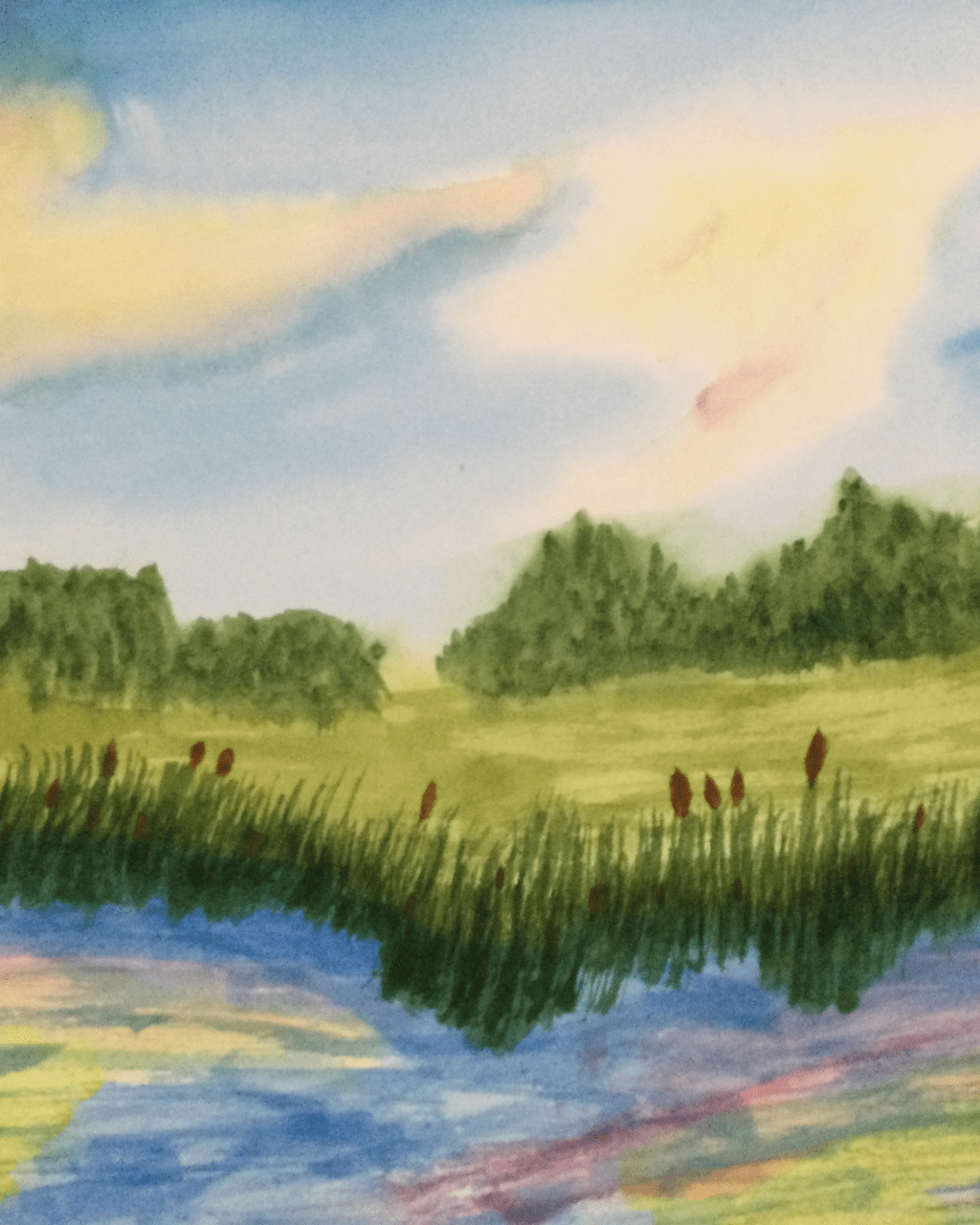
I decided to do a little experiment to see if I would be able to do the ‘landscape’ part of it on the smooth paper since I haven’t done that before. It was an interesting experiment, to say the least. The water sat on top of the paper longer, but once it started to soak in, it dried much quicker.
That meant I had to be very careful with how much water I was putting on the paper and work very quickly — much quicker than I’m comfortable with. That was really great practice in itself though. And since I had no preconceived notions of how it would turn out, that took the pressure off trying to get it right.
It allowed me to just have fun, do things I thought might work, and learn a little more about how everything works together. I wouldn’t exactly call it a success, but it gave me some good practice before I start the actual painting.
The Value of Experimenting
As I was doing this, I was thinking about the value of experimenting with things in our day to day lives as well.
If you ask my family, they’ll tell you I’m big on experiments. We laugh about my cooking experiments all the time, because I’m always coming up with new dishes and testing them out on family and friends. I can’t call them recipes, because I never measure anything — I just use “a little of this and a little of that.”
I’ve also experimented on myself more times than I could count when I was working as a personal trainer/health coach. I didn’t ever ask my clients to do something I hadn’t tried. In fact, I still experiment with things when it comes to living my healthiest life. For the record, that DOES NOT mean I try the latest new trend, or the never-ending stream of supplements on the market. I will, however, try out evidence-based health and fitness information for myself.
Trying out things for ourselves, looking at them as experiments, can sometimes free us to get out of our heads and embrace a new way of doing things.
That’s part of the growth mindset that we talked about in my post Watercolor Lessons 1. A growth mindset tells us that we can develop, improve, and cultivate our skills through effort and practice. We don’t have to expect things to work out perfectly all the time.
Having a growth mindset allows us to make mistakes without feeling bad about them. It tells us it’s okay to make those mistakes, that they’re actually learning experiences, that we really can become who we want to be if we’re willing to put in the work.
We try things, and if they work for us, great. If they don’t, we adjust and try something different. We don’t have to expect ourselves to be perfect. Looking at our efforts with curiosity, seeing them as experiments, can be incredibly freeing.
Have you found this to be true? If so, how has experimenting with things been helpful for you? Please share!


 I Wanna Be An Artist
Leave a reply to Terri, I Wanna Be An Artist Cancel reply