
“I’ve got to fix that thing. I’ve been looking at it for a year, and I still don’t like it.” I was looking at an eggplant I painted a year ago. When I first did it, I had painted some other fruits and vegetables and decided to hang them at the ends of my kitchen cabinets — just something to brighten up those blank wooden spaces.
I only had three to put up, though, and I knew I wouldn’t be able to stand seeing unbalanced cabinets. That meant I needed to do one more. I decided on an eggplant because of the color. The problem was, there wasn’t a tutorial for an eggplant, so I just tried to figure it out on my own.
I wasn’t really happy with it, but I didn’t know what to do to make it better. I went ahead and hung it up, and figured I’d just replace it with something else later on.
I often watch a show on PBS called Pocket Sketching with Kath McCauley. One day, she was talking about fixing mistakes, and she made the comment that you can go back as much as 10 years later and correct watercolors.
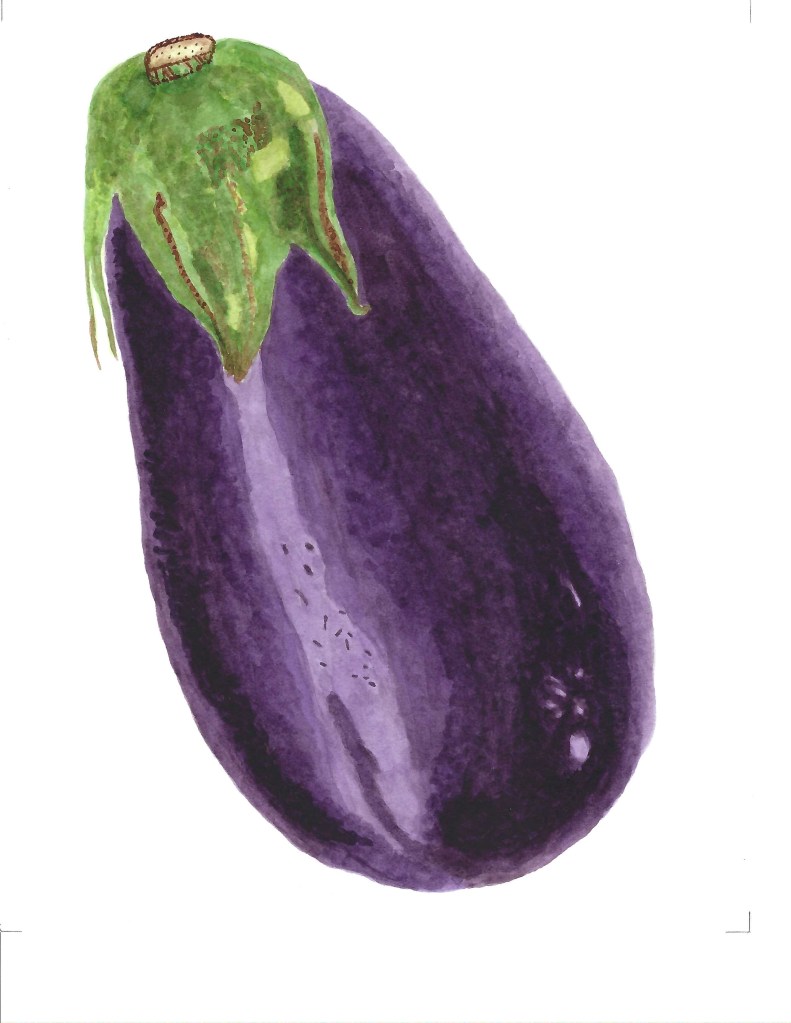
With that in mind, I figured I might as well try to fix my one-year-old eggplant. After all, if I messed it up, I could just paint something else to replace it. As I said, a year ago, I didn’t really know exactly what was wrong with it, so I didn’t know what I needed to do to fix it. All I knew was it looked flat, and nowhere near as realistic as my others.
My first step was to figure out exactly what was wrong.
Now that I’ve been practicing and learning more, one of the first things I noticed was that there was too much difference in the values (how light or dark it is).
Secondly, there wasn’t enough light on the right side, where the light would be coming from if were angled the way it is. It also didn’t seem to show enough curve in that side.
The other thing was that the lines in the cap were too sharp, so they’d need softening up a bit.
Once I knew what was wrong, I had to figure out the steps I needed to take to fix it.
My first step was to try to brighten up that right side to give the impression of light shining on it. I was able to lift some of the paint by using a damp cotton ball (NOT recommended — it left little pieces of cotton behind), followed by a damp paint brush. As I removed pigment, I made sure I worked in the direction of the form I wanted the eggplant to take. I think that helped with the curve I was missing too.
Next, I softened up the sharp lines I had in the cap. Now I know these aren’t in the same order of the problems I listed above, but there was a method to my madness.
In order to take care of the disparity in values, I had to actually determine what my lightest value should be, and adjust everything else. Also, the lines I needed to soften needed to be done before I put another layer of pigment over them.
Once I had taken care of the light and lines, it was time to lessen the difference between the lightest and darkest values. I did this by putting a glaze over the whole thing. That helped those differences not be so stark.
I also added a little shadow underneath, just to try to give it a little dimension.

This is the side-by-side comparison of the before and after. I’m not sure if anyone else would agree, but I think those little changes helped it look more realistic. I’m definitely much happier with it when I look up at it hanging at the end of my kitchen cabinet.
I know this was probably a long and boring story, but as I was thinking about going back and fixing this painting, I couldn’t help but think about how this could parallel our lives.
How many times do we make mistakes, or feel like we’re not happy with something, but just live with it? Maybe we think it’s been too long to change it, or maybe we don’t know what to do to change it. Either way, we just feel like we’re stuck with it.
I’m happy to report that’s rarely the case. It’s never too late to start something new, change the way we do things, or go back and correct past mistakes.
Just like we have the chance to go back and correct watercolors — even years after they’ve been painted — each day gives us an opportunity to make corrections.
We can’t always go back and completely erase our mistakes, but we can take actions to make things better. Sometimes it’s just a matter of taking that first small step; of figuring out what, exactly, we’re not happy with, then determining what steps we need to take next.
We don’t have to stay stuck where we are. We can take one small step at a time, moving with intention. It may involve having to step out of our comfort zone, but outside our comfort zone is where we see growth.
Have you ever felt stuck – either with a mistake, or just ‘life stuff’? What constructive ways did you find to deal with it? Please share!


 I Wanna Be An Artist
Leave a reply to Terri, I Wanna Be An Artist Cancel reply