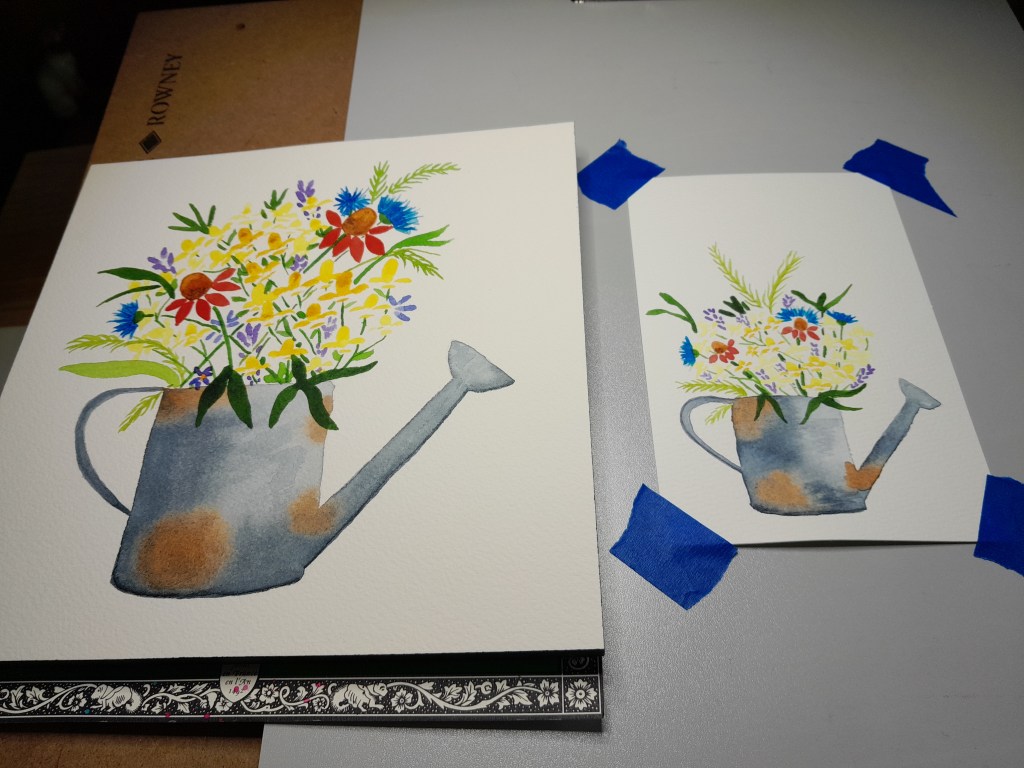
I’ve been painting a lot of things lately that when looking at the finished product, I might think are a regression. I say that because fairly early into my watercolor adventure, I started following an artist (still do) who paints very realistic-looking paintings, and of course, those were the things I was painting along with her. The things I’ve been painting lately look a lot more simple, and definitely not anywhere near as realistic.
As I mentioned a couple of weeks ago, I decided I needed to get back to the basics. I realized that in my hurry to start painting, I hadn’t really mastered the basic skills I need if I’m going to really progress as a watercolor artist. The basics are called that for a reason — they’re going to be the foundation of everything you do, and if the foundation isn’t solid — well, you know what happens…
As I mentioned before, I’ve dabbled in watercolors for a couple of years and I’ve had some good results when following along with tutorials. Of course, I’ve also had some really bad results, usually when I’ve tried to experiment on my own.
Following step-by-step tutorials is a great way to get started painting and be able to produce some things you’re proud of. All you have to do is do exactly what the instructor does.
The problem with that is that without mastering the basics of water, paint, and brush control (among other things), you can’t expect good results all the time, because you don’t really know what causes ‘good’ and ‘bad’ results.
Take water control for instance. I used to hold my breath until a painting dried, hoping I wouldn’t see the dreaded “bloom” where I had used too much water.
As I’ve been doing these simpler projects and really taking the time to try to master these basics, I’m realizing that it’s something I really needed to do. It’s been so helpful to really understand why certain things happen and it certainly helps me get more reliable results.
Of course, with watercolor, even when you do everything ‘right,’ unexpected things can happen. That’s part of the magic of watercolor though. Sometimes things just happen, and often they make a painting more interesting. I guess Bob Ross would call them happy little accidents.
I’d be remiss if I didn’t also say that having an instructor who really explains things in a way this Type A brain understands has made a HUGE difference. I’ve followed some great instructors online and they’ve all helped me learn, but Alex approaches things a little differently. It’s helping me feel more comfortable and giving me confidence that I may one day be able to paint something WITHOUT having to follow a tutorial.
Also, doing the more basic stuff helps me get those ‘miles on my paintbrush.’ I’m able to go back to my painting table and do a little project that I only have to work on for an hour or two and it’s done. Actually using these basic principles on an almost-daily basis really helps me see them at work, and figure out where I need to improve.
Now I don’t know why I needed a reminder to master the basics first. After all, I spent years saying this very same thing to people. If we want to be successful in anything, we have to master those foundational principles/actions that are going to be the building blocks for everything else.
That’s true no matter what we’re doing. Sometimes those basic things are boring. Sometimes they’re just things we don’t like to do. Other times, we may feel like we’re not making any progress because we’re doing the same thing over and over. BUT if we stick with it, make sure we really learn those vital building blocks and how to apply them, we’ll be much better off in the long run.
Have you ever had a time where you felt you needed to get back to the basics? How did you approach it? Please share!


 I Wanna Be An Artist
Leave a reply to Lessons In Watercolor 2 – I Wanna Be An Artist Cancel reply