So for all my talk about preparation in my last post, I was not prepared when it came to having a blog post for last week. We had to go out of town, and I was so busy preparing for that I didn’t even give a thought to the blog. Oh well, what can you do?
We got back on Wednesday afternoon, but I didn’t even attempt to pull anything out of my frazzled brain at that point. I did end up painting the last few days of the week though, and I actually completed my little landscape I talked about in the last post.

This was such a fun thing to paint, and it really was a great stress reliever as well. As I mentioned, I think painting landscapes is really where my heart is, and this is the first one I’ve done without some kind of tutorial.
I was nervous about painting it, because I didn’t want to mess it up, and that nervousness manifested itself in my reluctance to get started painting once I’d transferred my traced image onto the paper. That reminded me of one of the lessons I’d already learned, but evidently needed reminding of….
Sometimes we have to get out of our own way and JUST START.
I kept putting off painting because I didn’t want to mess it up. I had already traced and transferred, and swatched my colors…. and then it just sat there. I finally realized what I was doing, and I asked myself, “So what if you mess it up?” I mean, it’s not like I was working on some big masterpiece or something; it wasn’t a big deal if I messed it up. I could just trash it and start over.
Before I could change my mind I went straight back to my office and got started. I got the initial sky and water done and then left it alone until the next day. In the meantime, I did a little experimentation with a couple of techniques I wanted to use. That led me to the second thing I learned:
Experimentation is actually fun!
The longer I work at watercolor, the more I realize I really need to loosen up and work on having a growth mindset about this. I put way too much stock in the finished product, and that keeps me from enjoying the learning process sometimes.
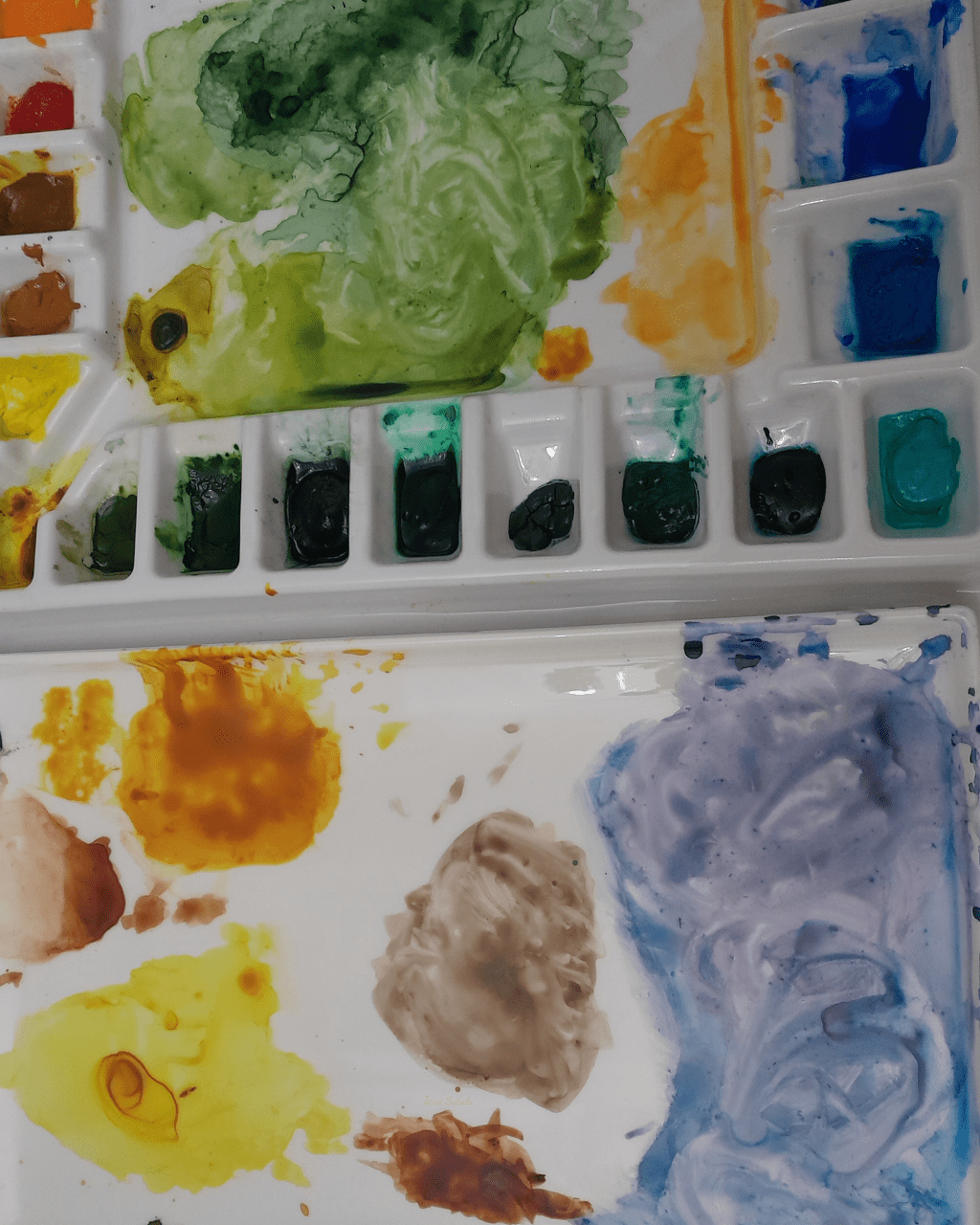
Taking the time to experiment with some of the colors and techniques I’d be using really helped me enjoy the process more AND feel a little more confident before I used those techniques on the painting. I actually had fun playing around with the paints!
While it’s fun to experiment and play around with things, if we want a successful painting, we have to do some planning.
Having a plan is important in watercolor.
You know, I’m exposing my ignorance here, but I think that somewhere in my mind, I had this idea that artists just had a moment of inspiration and started painting. I never thought about the work they do ahead of time to ensure what they envision shows up on the canvas/paper/walls, etc..
I now know it takes a whole lot more planning than I thought, and I think this is especially so for watercolor. For instance, if you want white, or you want highlights in certain places, you have to plan for them. Unlike oil or acrylic where you can put highlights in later, you have to be careful to preserve highlights from the very beginning, because the white comes from the paper, not from paint.
You also have to be careful with your color choices, because with watercolor, when you add layers, the layers underneath will also show through. If you’re not careful which colors you use, your colors could end up looking muddy, or the finished color could end up looking completely different than you intended.
Even when you have a plan, sometimes it’s hard to stop making those little adjustments. That leads me to the last thing I was reminded of with this one….
You have to know when to say, “good enough is good enough.”
I don’t think I’ve ever looked at anything I’ve painted and been completely satisfied with it. I keep finding little things I wish looked better, and I keep thinking, “okay, I’ll just do this and I’ll be finished.” The problem is, you can reach a point where you’ve tried to “fix” things so much that the painting just looks overworked.
Sometimes you just have to accept that it’s not going to be perfect. We’re our own worst critics, and I think there are many of us who, like me, are never completely satisfied. I’ve just had to learn to say, “good enough is good enough.” That doesn’t mean I’m giving it less than my best; it just means that I’m not holding myself to some unrealistic expectation of perfection.
Every time I get back to my painting table and paint, I learn something. I’ve always enjoyed it, but I think I’m starting to have a little more fun with it now that I’m getting some of those ‘miles on my paintbrush.’ Maybe I will be an artist one day.
Thanks so much for stopping by! I’d love to hear any tips you’ve learned while working in your chosen medium!


 I Wanna Be An Artist
I’d love to hear your thoughts!